 Historic Marker
Survey · January 25, 2026
Parts of a Landslide
As documented January 25, 2026.
- Survey date
- January 25, 2026
- Condition
- Good
- Condition notes
- Panel intact and fully legible; no fading, cracking, or graffiti visible. Sunlight glare across the lower right of the photograph.
Inscription
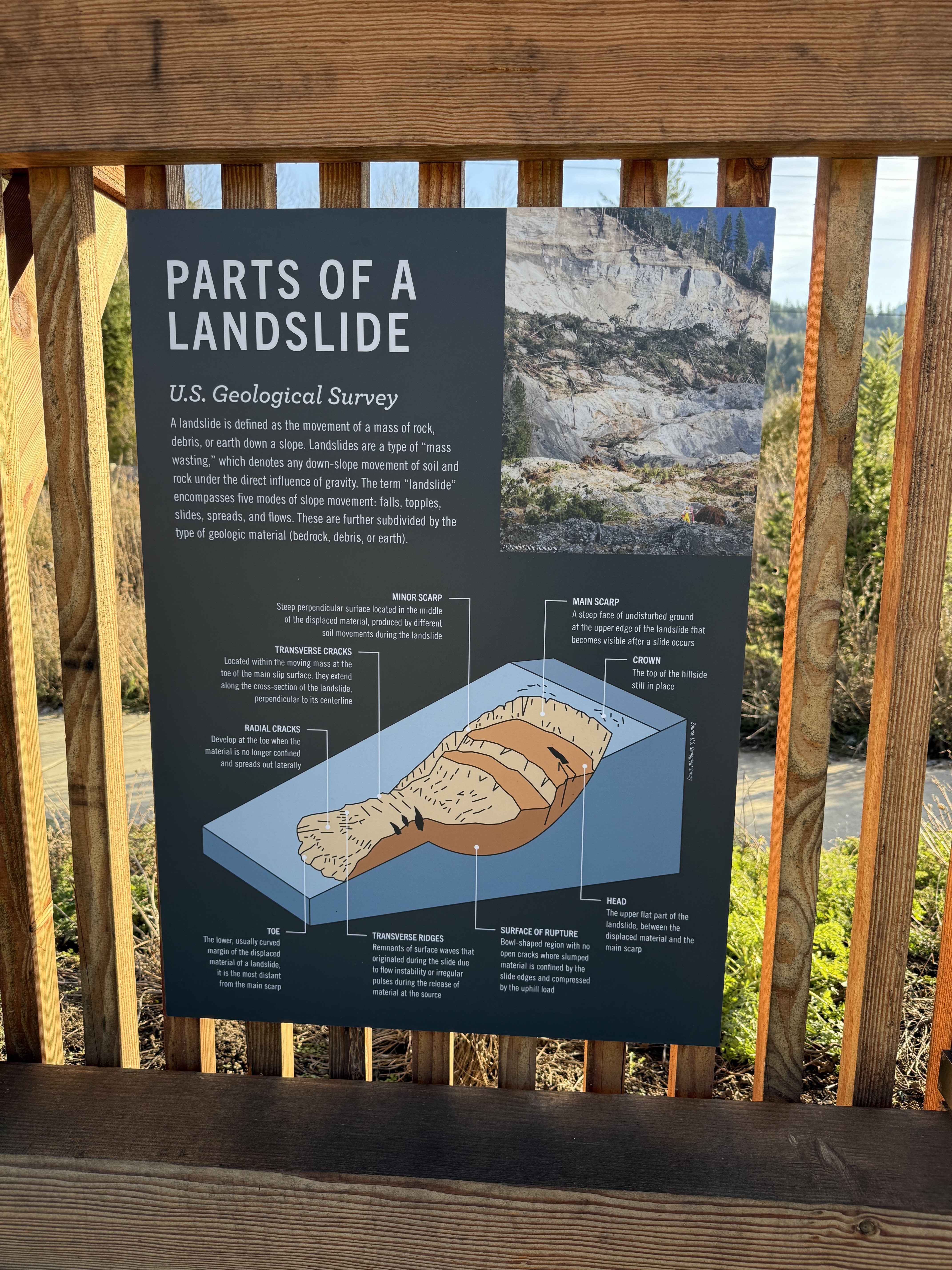
PARTS OF A LANDSLIDE U.S. Geological Survey A landslide is defined as the movement of a mass of rock, debris, or earth down a slope. Landslides are a type of "mass wasting," which denotes any down-slope movement of soil and rock under the direct influence of gravity. The term "landslide" encompasses five modes of slope movement: falls, topples, slides, spreads, and flows. These are further subdivided by the type of geologic material (bedrock, debris, or earth). [Photo, upper right: a landslide scarp of bare gray earth above a slope of downed trees and debris; a small figure in high-visibility gear at the base; an adjacent pale shape is unresolvable (second figure or gear)] [Credit printed in the photo's lower left corner:] AP Photo/Elaine Thompson [Diagram: cutaway block illustration of a landslide, each label joined to a point on the drawing by a leader line] MINOR SCARP Steep perpendicular surface located in the middle of the displaced material, produced by different soil movements during the landslide MAIN SCARP A steep face of undisturbed ground at the upper edge of the landslide that becomes visible after a slide occurs TRANSVERSE CRACKS Located within the moving mass at the toe of the main slip surface, they extend along the cross-section of the landslide, perpendicular to its centerline CROWN The top of the hillside still in place RADIAL CRACKS Develop at the toe when the material is no longer confined and spreads out laterally [Rotated 90° clockwise, reading top-to-bottom down the right edge of the diagram:] Source: U.S. Geological Survey TOE The lower, usually curved margin of the displaced material of a landslide, it is the most distant from the main scarp TRANSVERSE RIDGES Remnants of surface waves that originated during the slide due to flow instability or irregular pulses during the release of material at the source SURFACE OF RUPTURE Bowl-shaped region with no open cracks where slumped material is confined by the slide edges and compressed by the uphill load HEAD The upper flat part of the landslide, between the displaced material and the main scarp
Awaiting verification